Your browser version is too low, it may lead to sites not normally access!
You can use the site to function properly, use these browsers.
Your browser version is too low, it may lead to sites not normally access!
You can use the site to function properly, use these browsers.

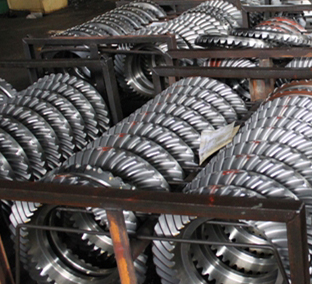
The finished precision, mechanical strength and service life of cylindrical gears depend entirely on the standardized processing procedure system. Different from the simple forming processing of conventional mechanical parts, cylindrical gear processing is a refined process system integrating blank shaping, tooth forming, precision trimming, heat treatment strengthening and final calibration. Fine adjustment of each process parameter will directly affect the subsequent transmission stability and working condition adaptability of the gears.
The first step in cylindrical gear processing is blank pretreatment, mostly adopting forging or bar turning forming technology. Forged blanks can break the loose structure inside the steel and realize continuous distribution of metal fibers, fundamentally improving the impact toughness and bearing performance of gears. For light-duty general gears, finishing turning is used to trim the outer circle, end face and inner hole of the blanks to ensure the coaxiality of basic dimensions and lay an accurate foundation for subsequent tooth processing. After shaping, the blanks will be normalized and quenched to eliminate internal stress generated by turning and forging, avoiding deformation during later finishing and equipment operation.
Tooth forming is the core link of processing. The mainstream mass production processes include gear hobbing and gear shaping. Gear hobbing is suitable for mass production of standard straight and helical cylindrical gears. With the continuous cutting characteristics of hobbing cutters, it features high processing efficiency and good tooth consistency, which is suitable for large-scale production of industrial general gears. Gear shaping is aimed at stepped gears, internal gears and special-shaped cylindrical gears with complex structures. It completes tooth processing through reciprocating cutting of slotting cutters, adapting to special structures that cannot be processed by ordinary hobbing equipment and meeting the needs of customized gear production. The formed tooth blanks will reserve a tiny finishing margin instead of being put into use directly.
Rough processing is followed by precision trimming, which is a key quality improvement step for high-precision cylindrical gears. For equipment gears with high transmission precision requirements, gear shaving is adopted to optimize tooth surface roughness and correct slight tooth direction errors for smoother meshing. For heavy-duty and high-precision equipment gears, gear grinding is used to completely eliminate heat treatment deformation defects, correct tooth profile and tooth direction deviations, upgrade the gear precision to a precise level, and avoid transmission jitter, abnormal noise and local eccentric wear.
Heat treatment strengthening is a key process that determines the durability of cylindrical gears. The conventional process adopts high-frequency tooth surface quenching, which only hardens the meshing area of the tooth surface and retains the toughness of the gear core, forming a structure with hard surface and tough core. It can not only resist tooth surface friction and wear, but also buffer heavy-load impact and prevent tooth breakage. Some high-end industrial gears adopt carburizing and quenching technology to further improve tooth surface hardness and fatigue resistance, adapting to long-term continuous heavy-load working conditions.
The final stage of the process includes finishing and precision inspection. Honing and finishing turning are used to correct tiny deformation caused by heat treatment and calibrate gear aperture, end face runout and tooth pitch error. Finally, professional gear testing equipment is used to verify core parameters such as tooth precision, surface hardness and roughness, eliminate defective products, and ensure that the finished gears can adapt to the stable transmission needs of various mechanical equipment.
The standardized processing technology enables cylindrical gears to balance precision, strength and toughness, and serves as the core process guarantee for their wide adaptation to various light and heavy industrial transmission scenarios.